


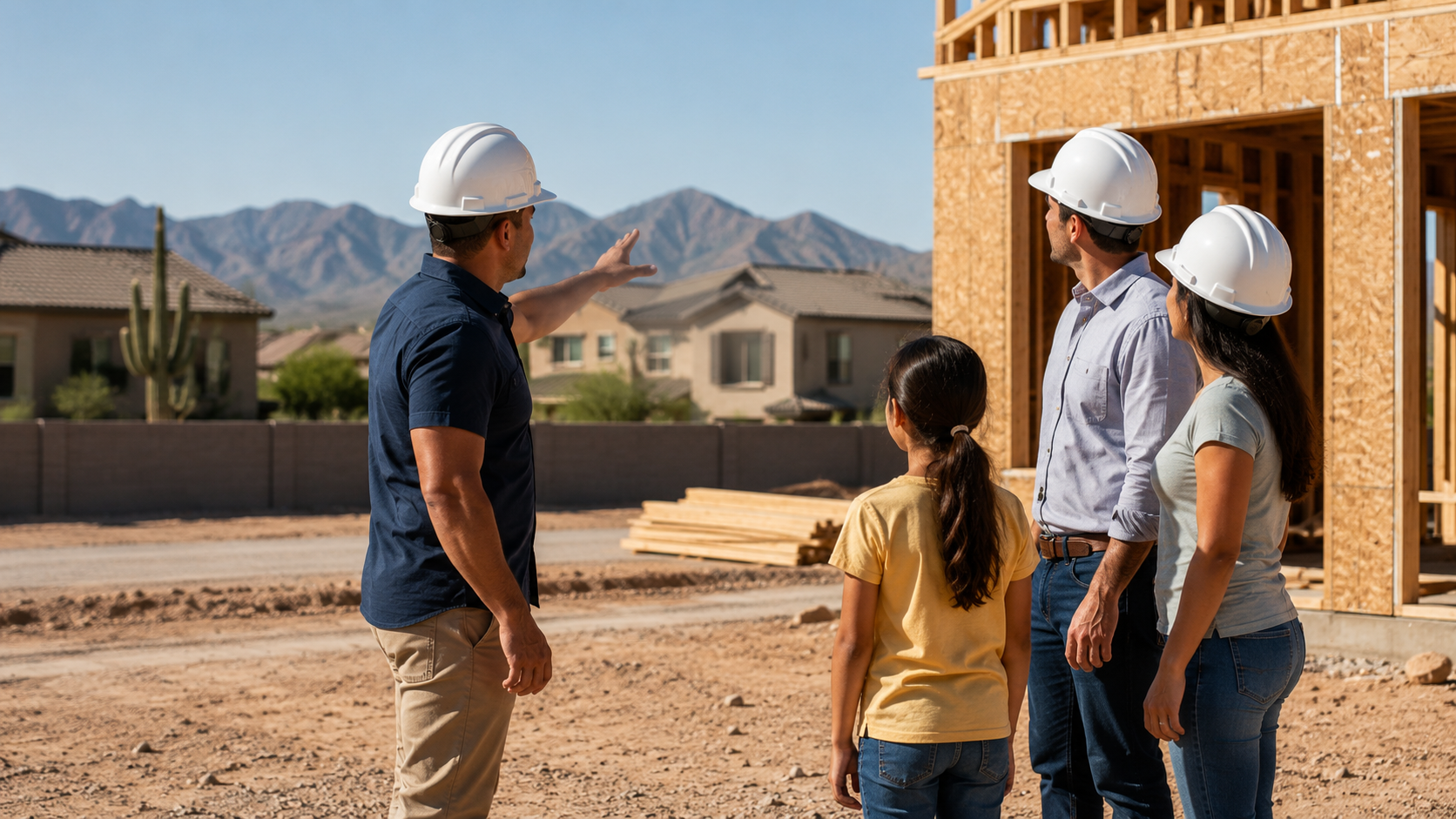
What to Negotiate When Buying New Construction in Gilbert & Queen Creek, AZ
What can you negotiate when buying new construction in Gilbert or Queen Creek, AZ?
When buying new construction in Gilbert or Queen Creek, Arizona, buyers can negotiate the base price (especially on inventory homes), lot premiums, builder-paid rate buydowns, upgrade credits, closing cost contributions, and third-party inspection rights. As of mid-2026, Queen Creek has over 450 new homes available from 18 active builders, giving buyers real leverage—if they know how to use it. The key is bringing your own buyer's agent before your first model home visit, understanding which homes have the most flexibility, and knowing what to ask for in writing.
By Megan & Jason Williams | June 14, 2026
Here's something the builder's sales office isn't going to volunteer: the person greeting you at the model home works for the builder. They're knowledgeable, friendly, and helpful—but they're contractually obligated to represent the builder's interests, not yours.
That doesn't mean you can't get a great deal on new construction in Gilbert or Queen Creek. It means you need to know what's negotiable, how to ask for it, and why having your own representation changes the entire dynamic.
We've helped hundreds of East Valley buyers purchase new construction homes across Gilbert, Queen Creek, Chandler, and the surrounding communities. Here's what's actually on the table.
The Queen Creek Pipeline and Why Leverage Exists Right Now
Queen Creek has one of the deepest new construction pipelines in the entire Phoenix metro. As of spring 2026, there are approximately 455 new construction homes available from 18 different builders. That's a significant inventory, and builders with homes sitting unsold are paying carrying costs every day those properties aren't closed.
Gilbert's situation is different. With limited land available, Gilbert sees far less new construction than Queen Creek—and what's available moves faster. If you're buying in Ironwood Crossing, Morrison Ranch, or another Gilbert community with new inventory, your window to negotiate may be shorter.
In Queen Creek—across communities like Seville, Eastmark-adjacent developments, and new builds near the San Tan Valley border—you have more options and more time. That changes what you can ask for.
The first rule: never walk into a model home without your buyer's agent registered first. Arizona's builder-broker code requires your agent to accompany you on your initial visit to a subdivision, or the builder can refuse to recognize their representation—meaning you'd lose the professional guidance you're entitled to at no extra cost.
What You Can Actually Negotiate
Not everything is flexible. But more is than you'd think.
Base price on inventory homes. Builders rarely drop the base price on presale (dirt) builds because it creates pricing inconsistencies across the subdivision. But on spec homes and quick move-ins that are already complete or near completion? The calculus changes. A builder carrying a finished home at $680,000 for three months may be willing to take $655,000 or stack significant incentives to close the deal.
Lot premiums. In any new construction community, certain lots command a premium—corner lots, cul-de-sacs, park-facing positions, or lots without neighbors directly behind. These premiums can range from $5,000 to $50,000 or more. On inventory homes or in slower-moving communities, builders will often waive or discount lot premiums entirely. It's one of the first things to ask about.
Mortgage rate buydowns. This is where we're seeing the most action in 2026. Several Queen Creek builders are offering permanent rate buydowns on quick move-in homes, with rates as low as 4.99%—well below current market rates. A 2/1 temporary buydown reduces your rate by 2% in year one and 1% in year two. On a $600,000 loan at 6.5%, dropping to 4.5% in the first year saves you roughly $600 per month.
Builders prefer to offer rate incentives through their preferred lenders. That's worth understanding: their lender isn't required to give you the best overall terms. Compare the builder's lender offer against your own financing options before you commit.
Upgrade credits. Flooring, cabinet finishes, appliance packages, countertops—the design center is where builders make significant margin. If you'd rather have closing cost credits than premium countertops, ask. If you want the upgrades, ask what they'd cost after-market versus what the builder is including. Your agent can help you assess whether an upgrade package adds real value at resale or is primarily a lifestyle spend.
Closing cost contributions. Builders routinely offer closing cost credits, especially when interest rates make monthly payments a sticking point. In East Valley communities in mid-2026, the average seller or builder concession is running around 2% of the purchase price. On a $650,000 home, that's $13,000 toward your closing costs—which can meaningfully reduce what you need to bring to the table at closing.
Independent inspection rights. New construction homes have defects. Framing issues, HVAC installation problems, improper grading—these aren't common, but they happen, and a builder's warranty doesn't always resolve them quickly. Make sure your contract allows for an independent home inspection before closing and ideally a pre-drywall inspection during construction. Don't sign away this right.
The Costs Builders Don't Lead With
Before you compare builders on base price, you need to understand the full cost of entry into a new construction community.
Capital improvement fees. Many master-planned communities in Queen Creek, Chandler, and Gilbert—including Eastmark, Ironwood Crossing, and Power Ranch—charge a one-time capital improvement fee at closing. This typically runs 0.5% to 1% of the purchase price and funds the HOA's community reserve. On a $650,000 home, that's $3,250 to $6,500 due at closing, on top of your other closing costs. Ask before you fall in love with a community.
HOA dues. Morrison Ranch in Gilbert runs around $429 per quarter. Power Ranch neighborhoods vary but tend to be in a similar range. New communities often start with lower dues that increase as amenities come online. Factor the HOA cost into your monthly payment calculation from the start.
Landscaping. New construction homes in Arizona almost always transfer with a blank-slate backyard. Landscaping costs in the East Valley run $8,000 to $30,000 or more depending on lot size, trees, patio, and artificial turf versus natural grass. Budget for it. Some buyers use the builder's upgrade budget on landscaping credits or negotiate with the builder to do the front yard, at minimum.
Pinal County vs. Maricopa County taxes. Some Queen Creek homes fall in Pinal County rather than Maricopa County. Pinal County's effective property tax rate runs slightly higher—approximately 0.72% versus 0.62% in Maricopa. On a $650,000 home, the annual difference is about $650. Not a dealbreaker, but worth knowing when you're comparing two communities that look similar on paper.
How to Work This Process
Register your buyer's agent before stepping into any model home. This protects your representation rights from day one and costs you nothing—builders pay the buyer's agent commission.
Ask for the full incentive sheet in writing before your first visit. Incentives change constantly, and what's offered today may not be available next week. Get it in writing so you have a baseline to negotiate from.
Focus your negotiating energy on inventory and quick move-in homes. These have the most flexibility on price, lot premiums, and stacked incentives. If you're willing to close in 30 to 60 days, you have leverage—use it.
Compare total monthly cost, not just the base price. A builder offering a $620,000 base with a 4.99% permanent rate buydown and a waived lot premium may pencil out better on a monthly basis than a $595,000 base at current market rates with no incentives. We run this math for our clients before they ever sign a contract.
When you're buying in Queen Creek, Gilbert, or anywhere in the East Valley, the builders are experienced at what they do. Having someone in your corner who's walked through this process hundreds of times—and who knows how these deals get structured—changes the outcome.
Frequently Asked Questions
Do I need a buyer's agent for new construction in Arizona?
Yes—and it costs you nothing extra. In Arizona, builders pay the buyer's agent commission, so you get professional representation at no additional cost. The builder's on-site sales rep works for the builder, not you, and is contractually obligated to protect the builder's interests. Having your own agent means you have someone reviewing the contract, negotiating on your behalf, and advising on lot selection, upgrade value, and resale potential.
Can I negotiate the price on a new construction home in Gilbert or Queen Creek?
Yes, especially on inventory and spec homes that are already complete or nearly finished. Builders are highly motivated to move these homes since finished inventory carries ongoing costs. On dirt builds—homes you contract before construction starts—builders are less likely to reduce the base price, but you can still negotiate lot premiums, closing cost credits, and upgrade packages.
What is a rate buydown and how much can it save me?
A rate buydown is when the builder pays to temporarily or permanently lower your mortgage interest rate. A 2/1 buydown reduces your rate by 2% in year one and 1% in year two before settling at the note rate. On a $600,000 loan, a builder-paid buydown from 6.5% to 4.5% in year one can save you $400–$600 per month. As of mid-2026, several Queen Creek builders are offering permanent buydowns to rates as low as 4.99% on quick move-in homes.
What is the difference between a spec home and a dirt build in Arizona new construction?
A spec home is a home the builder has already started or finished without a specific buyer under contract. These offer faster move-in timelines—sometimes 30 to 60 days—and the most negotiating leverage. A dirt build is when you contract with the builder before construction starts. You get more customization options but wait 6 to 12 months for completion, and the builder has less financial pressure to negotiate on price.
What is a capital improvement fee and do new construction communities in Queen Creek charge it?
A capital improvement fee is a one-time charge the buyer pays at closing to fund the HOA's community reserve. In master-planned communities across Queen Creek, Chandler, and Gilbert—including Eastmark, Ironwood Crossing, and Power Ranch—this fee runs 0.5% to 1% of the purchase price. On a $650,000 home, that's $3,250 to $6,500 due at closing on top of standard closing costs. Always ask about this before you sign.
New construction in Queen Creek and Gilbert offers real value—builder incentives, energy-efficient builds, and modern floor plans that resale homes can't match. But the deals go to buyers who know what to ask for and have someone in their corner who's done this before.
If you're thinking about new construction in Gilbert, Queen Creek, Chandler, or anywhere in the East Valley, we'd love to walk you through what's available and what's actually negotiable right now. Reach out to Megan & Jason Williams and let's take a look at your options together—no pressure, no pitch, just straight talk about what makes sense for your situation.
About Megan & Jason Williams
Megan & Jason Williams are a husband-and-wife REALTOR® team with 18 years of experience and 700+ homes sold across the Phoenix East Valley. Based in Gilbert, Arizona, they specialize in helping relocation buyers and out-of-state families find the right home in Gilbert, Queen Creek, Chandler, and surrounding communities—with the no-BS, straight-talk approach you'd expect from people who made the move themselves. Reach them at 480-618-1890 or Megan@mail.homeinfoaz.com.